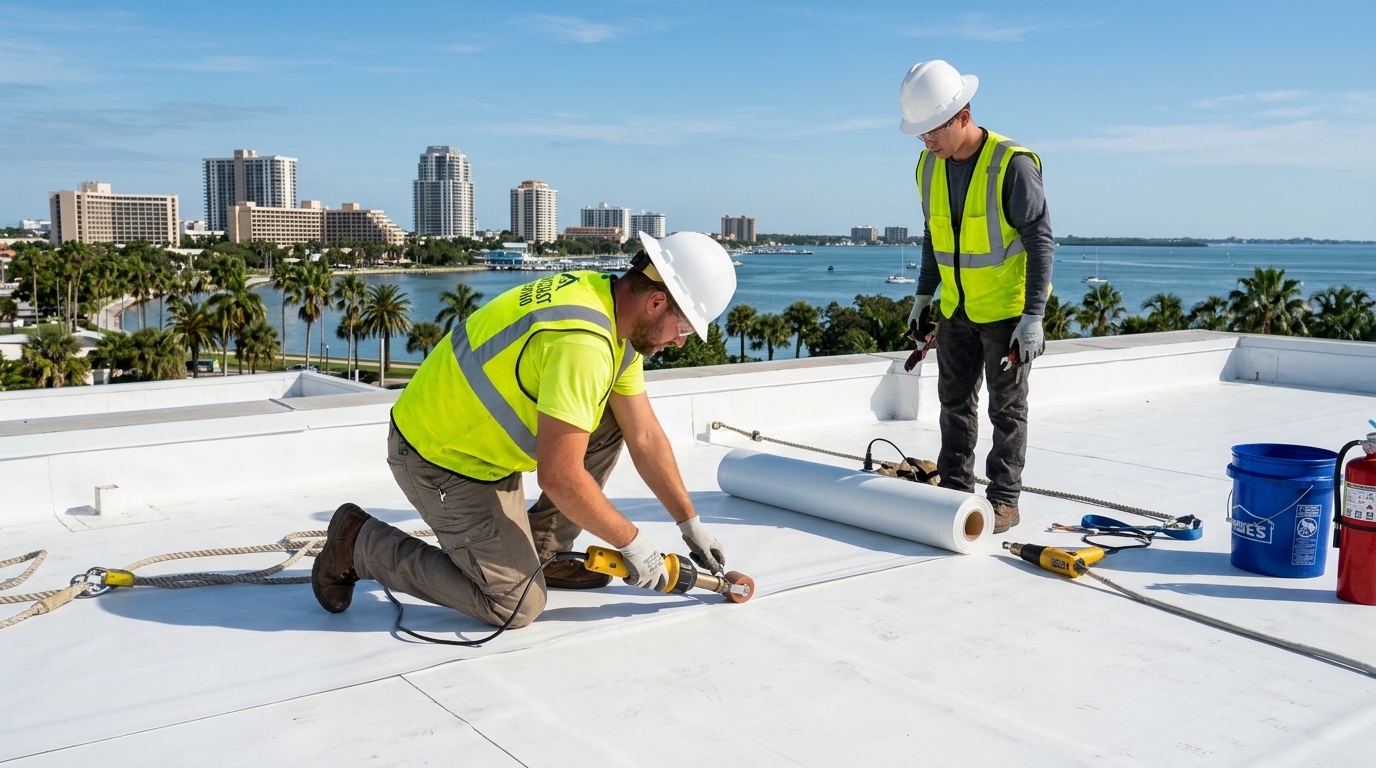
Metal roofing systems - prized across Nashville for their modern aesthetic, longevity, and high-wind resistance - require specialized engineering when damaged by severe storms. Whether dealing with tornado wind-lifted standing seams, hail impact pitting, or thermal fastener back-outs on agricultural barns and residential additions, RoofExpertUSA dispatches skilled metal roofing craftsmen.
Precision Restoration for Standing Seam & Exposed Fastener Metal Roofs
Metal roofing is widely celebrated for its durability, but it is not impervious to the violent forces of Middle Tennessee weather. Residential and commercial metal roofs in our region fall primarily into two structural categories: architectural standing seam systems (featuring concealed clips and raised interlocking ribs) and agricultural/utility corrugated panels (secured with exposed mechanical screws). Each system requires distinct forensic diagnostic and restoration approaches.
On exposed fastener panels, the primary source of failure is thermal cycling. As temperatures fluctuate between winter freezes and 95-degree summer days, metal panels expand and contract significantly. This cyclical motion rocks exposed screws back and forth, elongating fastener holes in the steel panels and chewing through neoprene washers. Eventually, screws back out or loosen, allowing wind-driven rain to stream into underlying framing rafters. Dispatched crews replace backed-out screws with oversized, self-drilling fasteners fitted with UV-stabilized EPDM vulcanized washers, bedded in elastomeric polyurethane sealant.
Interlocking Rib Re-Seaming: Hand-crimping or mechanical seam-rolling loosened standing seams along roof hips, eaves, and ridges that have been rattled by tornado vortex winds.
Concealed Clip Structural Re-Anchoring: Excising damaged panels and installing heavy-duty stainless steel sliding clips to accommodate natural thermal expansion without buckling.
Transition Flashing Waterproofing: Re-fabricating custom metal sidewall transitions, high-ridge caps, and valley liners using matching Kynar 500-finished steel or aluminum.
Cosmetic & Functional Hail Denting Audits: Evaluating whether severe hail impacts have broken protective fluoropolymer paint coatings, leaving panels vulnerable to galvanic corrosion.
Fast Dispatch for Wind-Rattled & Leaking Metal Roofs
A vibrating or rattling metal roof panel during severe wind is an urgent warning sign of compromised fasteners or loosened perimeter clips. Dispatched metal roofing contractors arrive with specialized sheet metal brakes, seam crimpers, and high-performance sealing compounds to stabilize loose panels, eliminate annoying rattles, and secure building envelopes against water damage.
Direct Phone-to-Crew Routing
Metal Roof Repair Services in Nashville, TN In Nashville? Connect Now
Do not wait for active water infiltration to compromise rafters, sub-fascia, and ceiling drywall. Our Nashville dispatch team connects you immediately with licensed, insured local roofing contractors equipped for rapid mitigation.
1. Middle Tennessee Tornado Corridor & Severe Wind Shear Dynamics
Nashville and the surrounding Middle Tennessee basin occupy a high-risk meteorological zone colloquially known as "Dixie Alley." Unlike traditional Midwestern plains tornadoes that occur primarily during daylight hours in wide-open agricultural terrain, Middle Tennessee storm systems frequently spawn nocturnal supercells, localized EF-0 to EF-3 tornado funnels, and severe straight-line downbursts exceeding 70 to 95 mph. When warm, moisture-laden air masses surge northward from the Gulf of Mexico and interact with dry polar jet streams descending over the Cumberland Plateau, atmospheric instability triggers rapid vortex spin-up across Davidson, Williamson, Rutherford, Sumner, and Wilson counties.
For residential and commercial roofing envelopes throughout Nashville, Davidson County & Middle Tennessee, these violent convective wind events produce acute localized uplift forces. As high-velocity airflow hits vertical exterior masonry or siding, it separates sharply at roof eaves and rakes, generating intense negative pressure vortices. Standard laminated architectural shingles experience rapid cyclic tab deflection, snapping internal fiberglass reinforcement mats and rupturing asphalt sealant lines. Once a single shingle tab lifts, wind-driven horizontal rain is forced beneath synthetic underlayment, rapidly saturating 7/16-inch OSB or 1/2-inch CDX plywood sheathing and compromising building envelope integrity.
Primary Middle Tennessee Storm Damage Hazards:
Tornado Vortex Uplift: Negative barometric suction stripping ridge caps, hip shingles, and entire decking panels along prevailing storm tracks.
Severe Hail Impact Delamination: Large hail (1.25" to 2.5"+) shattering mineral granules, micro-fracturing fiberglass carriers, and exposing asphalt substrates to rapid UV breakdown.
Mature Tree Canopy Punctures: Heavy hardwood limbs from Nashville's abundant oak, hickory, and maple canopies penetrating roof diaphragms.
Flash Valley Flooding: Sudden 2-to-4 inch hourly rain inundations overwhelming internal valleys, dead valleys, and parapet drain scuppers.
Thermal Cycling Seam Stress: Extreme seasonal temperature deltas (sub-freezing winter ice storms to 98°F summer heat) inducing cyclic expansion in metal roof fasteners and elastomeric flashing collars.
Accurately diagnosing storm-related water intrusion across complex Middle Tennessee roof systems requires scientific precision rather than destructive structural probes. Dispatched roofing contractors utilize calibrated FLIR (Forward-Looking Infrared) thermal imaging systems operating within the 7.5 to 14 μm spectral range. Because water possesses a significantly higher thermal mass than dry fiberglass insulation, cellulose, framing lumber, and drywall, moisture-saturated building materials retain solar heat longer into the evening. During the post-sunset radiative cooling cycle, FLIR thermal imaging detects precise infrared temperature deltas, mapping hidden moisture travel routes beneath multi-layered shingles, low-slope membranes, and attic crawlspaces down to the exact rafter bay.
Thermal findings are systematically cross-verified using non-invasive electronic moisture scanners (such as Tramex Dec Scanner and Delmhorst Dual-Depth impedance meters). These diagnostic instruments emit high-frequency radio signals up to 4 inches into composite roof substrates, evaluating dielectric permittivity shifts caused by trapped water without puncturing pristine waterproofing layers. For concealed chimney cricket flashings, internal dormer valleys, and boxed soffit junctions, technicians deploy high-definition micro-optical articulating borescopes to inspect framing rafters, detecting mold spore growth and wood decay before interior drywall collapses.
Nashville Advanced Diagnostic Protocol:
Radiometric Infrared Thermography: Capturing thermal anomalies across roof surfaces and ceiling plenums post-storm.
Restoring storm-compromised roof diaphragms in Nashville, Davidson County & Middle Tennessee requires disciplined engineering standards that exceed baseline building codes to guarantee long-term resistance against future Middle Tennessee weather extremes:
Phase 1: Controlled Hazard Isolation & Exposure Removal: Certified technicians set up OSHA-compliant personal fall arrest anchorages (29 CFR 1926.502) and systematically excise all torn, creased, wind-lifted, or hail-bruised shingles surrounding the damage perimeter down to bare structural decking.
Phase 2: Substrate Inspection & Decking Reconstruction: Exposed sheathing is inspected for moisture rot, deflection exceeding 1/4 inch, and fungal decay. Compromised panels are cut back to rafter centerlines and replaced with APA-rated 1/2-inch CDX exterior plywood or 7/16-inch OSB, fastened with hot-dipped galvanized 8d ring-shank nails driven at 6-inch perimeter and 12-inch intermediate field spacing to meet 115+ mph wind shear specifications.
Phase 3: High-Performance Underlayment & Ice Barrier Application: Over the prepared substrate, technicians install premium self-adhering polymer-modified bitumen secondary water barriers (meeting ASTM D1970) across eaves, valleys, and critical flashings. Breathable high-tensile synthetic underlayment (ASTM D226/D4869) covers the remaining field, mechanically secured with gasketed plastic cap nails.
Phase 4: Precision Interlocking Component Reinstallation: Matching architectural laminate shingles (Class A fire rated, ASTM D3462) are woven into the existing roof field. Shingles are fastened using an enhanced 6-nail high-wind pattern placed strictly below the sealant line to achieve 130 mph wind resistance ratings.
Phase 5: Flashings Integration & Polyurethane Sealing: All adjoining step flashings, chimney counter-flashings, and vent pipe collars are integrated with rust-resistant 26-gauge galvanized steel or aluminum, bedded in high-solids polyurethane elastomeric sealants (ASTM C920 Class 25) that maintain dynamic flexibility across Tennessee's 100-degree annual thermal swings.
4. Tennessee Building Codes & Contractor Licensing Compliance
All repair dispatch operations in Nashville, Davidson County & Middle Tennessee strictly adhere to the Tennessee State Building Code (incorporating the International Residential Code [IRC] with Tennessee State Amendments) and local metropolitan municipal ordinances enforced by the Metropolitan Government of Nashville and Davidson County Codes Department:
Tennessee Contractor Licensing: For roofing repairs exceeding ,000, Tennessee law (T.C.A. § 62-6-102) mandates an active Tennessee Board for Licensing Contractors Home Improvement or General Contractor license. For projects under ,000, contractors maintain registered local trade credentials, active local business permits, and statutory general liability insurance.
High-Wind Fastening Specifications: In accordance with local Davidson and Williamson county wind maps, all asphalt shingle replacements require 6-nail fastening patterns with corrosion-resistant 11-gauge or 12-gauge barbed ring-shank roofing nails penetrating at least 3/4 inch into or through structural roof sheathing.
Drip Edge & Valley Flashing Codes: IRC Section R905.2.8.5 requires approved corrosion-resistant sheet metal drip edge installed along all eaves and rakes with a minimum 2-inch roof deck flange overlap. Valley linings must meet minimum 26-gauge corrosion-resistant sheet metal specifications.
Balanced Attic Ventilation Ratios: IRC Section R806 mandates 1 square foot of net free ventilating area for each 150 square feet of vented attic space, balanced equally (50/50 ratio) between continuous soffit intake vents and high-efficiency ridge exhaust vents to prevent moisture condensation and premature shingle blistering.
5. Preventative Property Maintenance & Severe Storm Preparedness
Systematic maintenance is the single most effective safeguard against sudden catastrophic storm loss in Nashville, Davidson County & Middle Tennessee. Property owners should implement a structured bi-annual inspection protocol to identify and correct latent roof envelope vulnerabilities:
Bi-Annual Valley & Gutter Debris Removal
Regularly clear fallen oak leaves, sweetgum balls, and pine needles from roof valleys and gutter sumps. Clogged drainage channels cause torrential rainwater to back up underneath shingle courses.
10-Foot Tree Canopy Radial Clearance
Prune mature hardwood branches back at least 10 feet from the roof plane. Deflecting branches scour protective asphalt granules during windstorms and risk catastrophic punctures during severe nocturnal squalls.
Pipe Boot Elastomeric Collar Audits
Inspect plumbing vent stack flashings every 3 years. Tennessee's high summer UV radiation hardens and splits neoprene rubber collars within 5 to 7 years, creating direct annular leak paths into ceiling joists.
Attic Sheathing & Truss Visual Scans
Perform attic walk-throughs following severe weather events. Search for dark water stains, rusted shingle nail shanks, displaced insulation batts, and musty odors before leaks penetrate interior finished drywall.